Tools
Figma, After Effects, Canva
Duration
8 weeks
Focus
Healthcare +
Assistive AR Systems
OVERVIEW
Designing a context-aware augmented reality wearable that supports medication adherence, spatial orientation, and daily task continuity for individuals living with early-stage dementia.
THE PROBLEM
Supporting Daily Independence in Early-Stage
DementiaIndividuals with early-stage dementia often experience:
Forgotten medication doses
Disorientation in public spaces (e.g., supermarkets)
Interrupted task sequences in familiar environments like kitchens
While caregivers provide support, constant supervision reduces autonomy and dignity.
Existing assistive solutions:
Depend heavily on smartphones
Require manual interaction
Deliver overwhelming notifications
Lack contextual awareness
The challenge was to design a non-intrusive assistive system that reinforces memory and safety without increasing cognitive burden.
DESIGN CHALLENGE
RESEARCH SUMMARY
(Conceptual Exploration)
This project was informed by:
Secondary research on early-stage dementia behavior patterns
Analysis of medication adherence challenges
Study of spatial disorientation triggers
Review of cognitive load principles
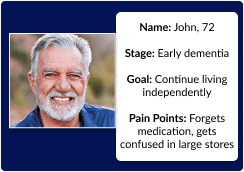
KEY INSIGHTS
Simplicity reduces anxiety.
Contextual prompts are more effective than persistent reminders.
Visual clutter increases confusion.
Caregiver backup should be invisible unless needed.
DESIGN PRINCIPLES
Routine Reinforcement
Support daily habits through time and context-based triggers.
Context-Aware Assistance
Surface help only when deviation or risk is detected.
Minimal Cognitive Footprint
Short language. Low contrast distractions. Binary choices.
Safety-First Escalation
Autonomy first, caregiver backup when necessary.
The design strategy focused on reducing cognitive overload while reinforcing routine stability. The system behaves as a quiet assistant — intervening only when deviation from normal behavior patterns is detected.
SYSTEM ARCHITECTURE
The system analyzes routine patterns and detects deviations such as missed medication, prolonged inactivity in unfamiliar store zones, or unsafe kitchen conditions. Prompts are delivered contextually and fade when resolved.
Scenario:
Stove remains active beyond safe duration.
AR Interface:
Object-anchored prompt near stove
“Stove is still on.”
Confirmation via nod or voice
If ignored multiple times → caregiver notified.
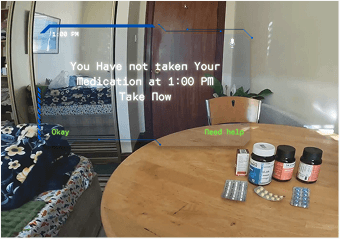
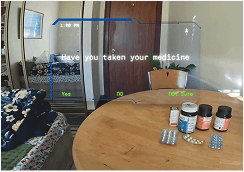
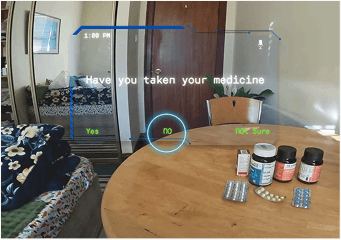
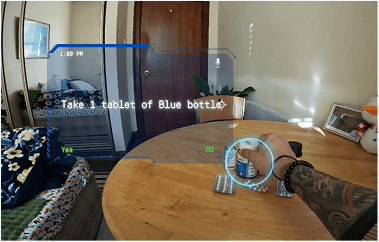
Peripheral cues prevent blocking vision.
Short text reduces processing load.
Scenario:
Stove remains active beyond safe duration.
AR Interface:
Object-anchored prompt near stove
“Stove is still on.”
Confirmation via nod or voice
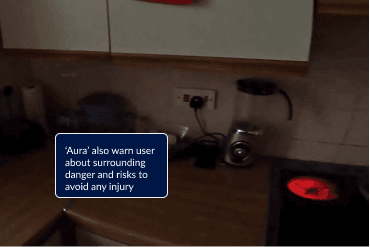
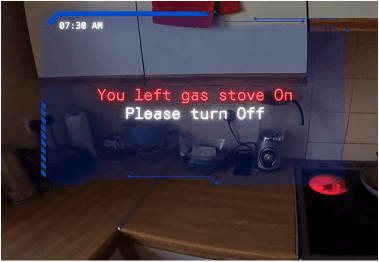
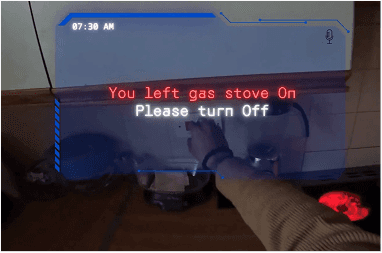
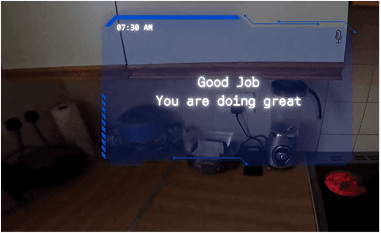
Contextual positioning reduces confusion.
No full-screen overlay, Red color for warning signs
ACCESSIBILITY
Designing for Cognitive Simplicity
Since ACHI supports individuals with early-stage dementia, accessibility focused primarily on reducing cognitive burden rather than adding features.
Key Accessibility Considerations
Binary choices instead of complex menus
Short, direct language
No persistent notifications
Peripheral placement to avoid blocking vision
Predictable interface behavior
ITERATION
(Concept Refinement)
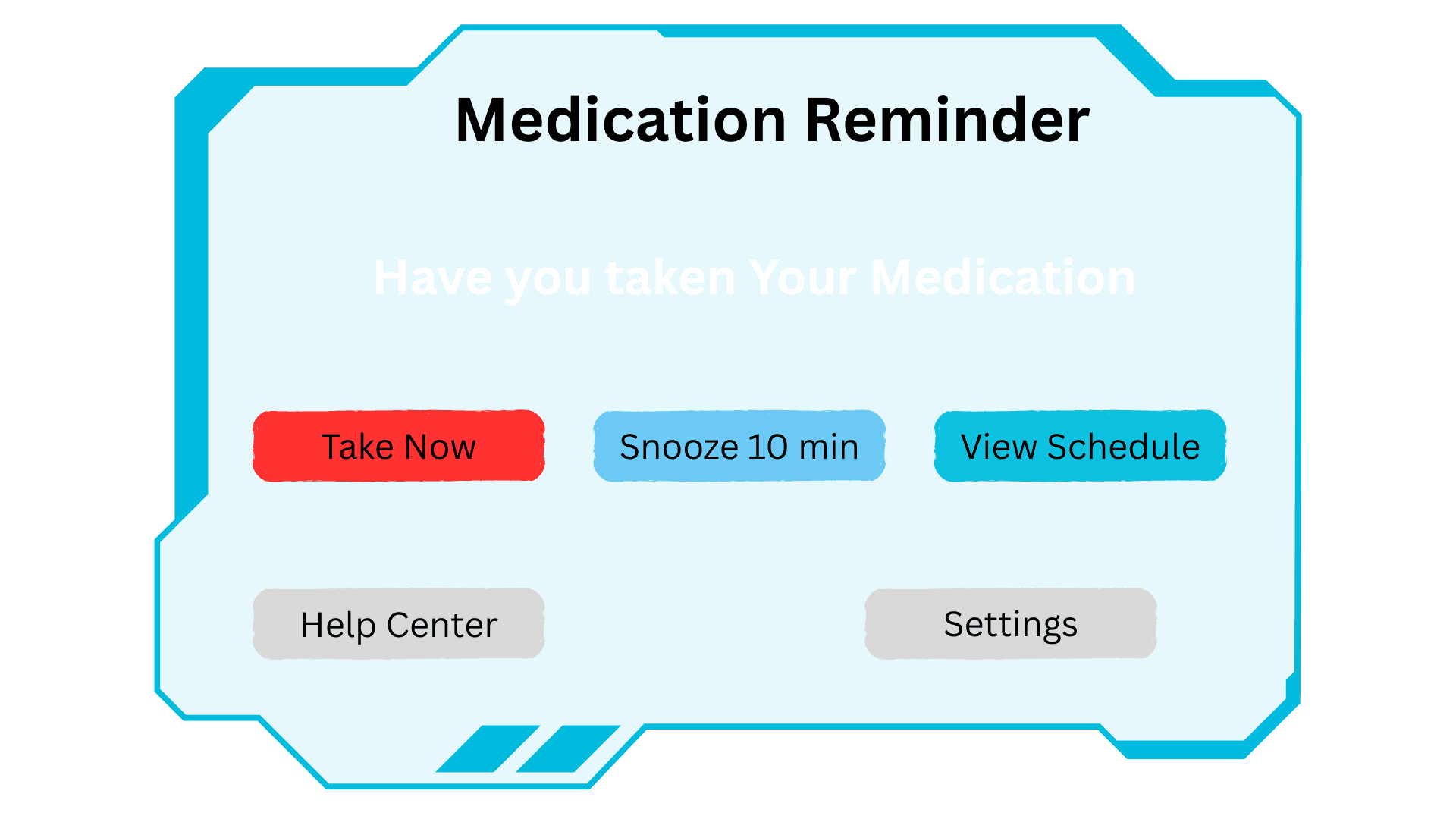
Since this is a conceptual academic project, iteration was based on cognitive design evaluation rather than live user testing.
Initial Concept
Larger central overlays
Persistent reminders
More visible UI elements
Refined Concept
Peripheral-only prompts
Context-triggered activation
Reduced visual density (~40% fewer on-screen elements)
ETHICS
Designing with Dignity and Privacy
Healthcare technology requires careful ethical consideration, particularly when involving location tracking and routine monitoring.
Ethical Principles Applied
Caregiver alerts only triggered after non-response
No unnecessary continuous tracking
Transparent permission-based data sharing
Local processing prioritized where possible
Language avoids highlighting cognitive decline
LIMITATIONS
Project Constraints
As a conceptual academic exploration, several limitations remain:
Hardware feasibility not validated
Indoor positioning accuracy dependent on real sensors
Object recognition performance hypothetical
Clinical validation pending
FUTURE DEVELOPMENT
Current Stage:
Concept simulation & system modeling
Next Stage:
Hardware prototyping
Clinical usability testing
Pilot testing in controlled environments
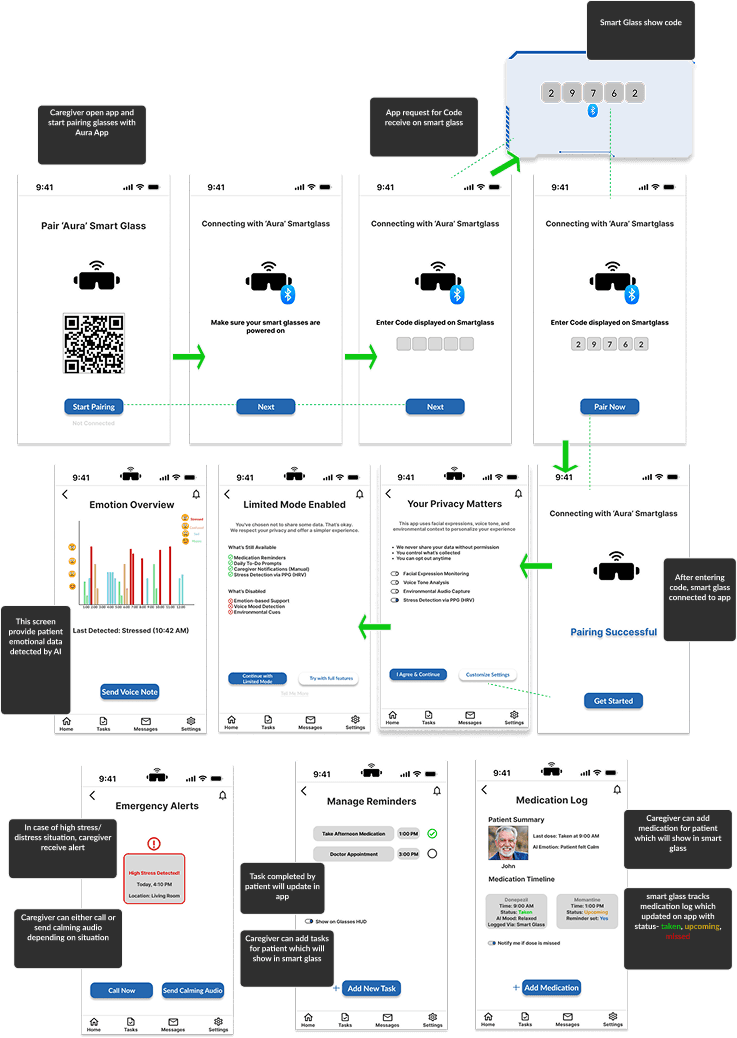
AURA MOBILE APP FOR CAREGIVER
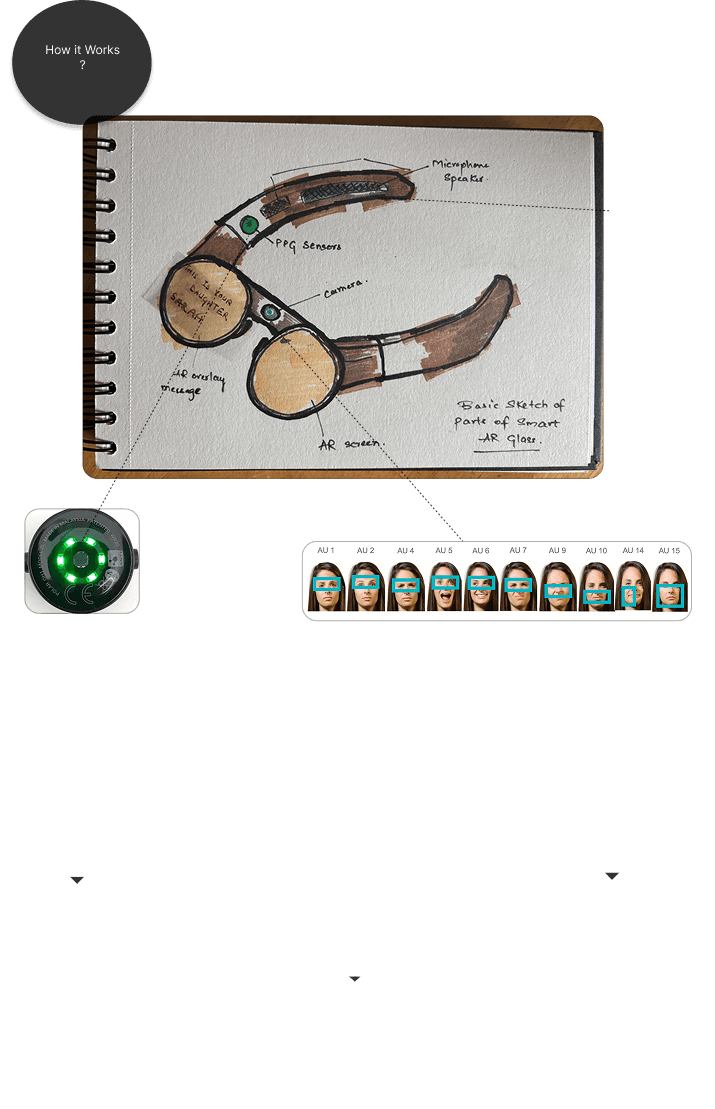
As the user experiences confusion or emotional stress, the smart glasses detect subtle cues through facial expressions, voice tone, breathing patterns, and physiological signals (e.g., HRV via PPG sensors). The AI assistant integrated in smart glass ‘Aura’ offers calming prompts and context-based support, such as reminding the purpose of a task or providing a visual shopping list. This walkthrough helps demonstrate the potential of emotion-aware augmented reality (AR) to empower dementia patients, reduce stress, and ease caregiver burden by promoting more stress free daily living.